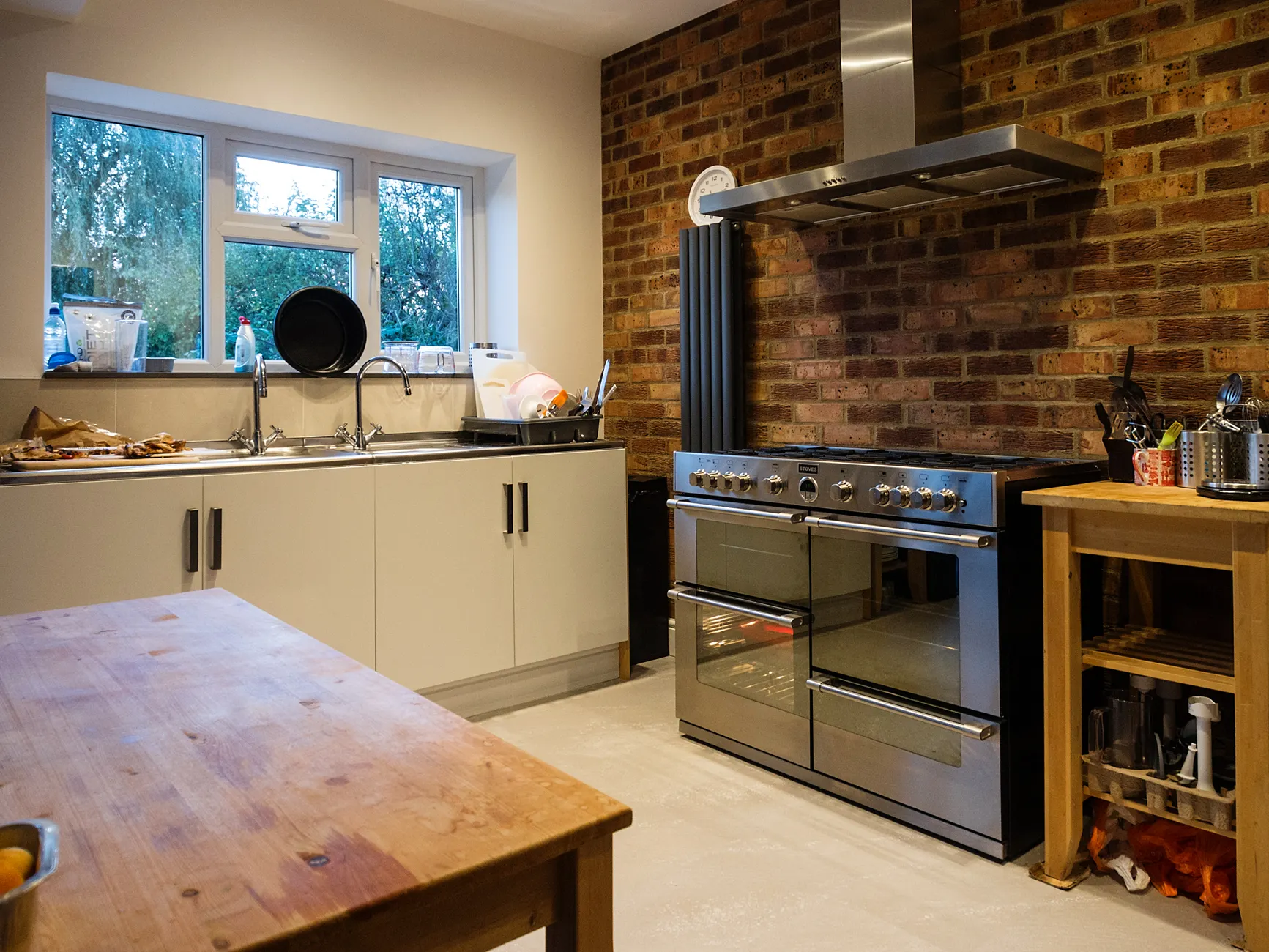
Santa Monica Kitchen Remodel And Bath Co works on the kind of homes that make the Westside what it is: a 1920s Spanish Colonial Revival bungalow whose kitchen has not been touched since the Reagan era, a North of Montana estate ready for a whole-home reset, a Mar Vista backyard about to become an ADU. We work out of downtown Santa Monica, at 600 Santa Monica Blvd, and we organize the whole operation around this coastline on purpose — because the older, high-value stock here, the state's ADU boom, and the thick layer of coastal, historic and Title 24 rules all reward a remodeler who takes the ground seriously.
We are a design-build firm: one team from the free in-home consultation and 3D design through the written estimate and the finished build. What follows is the plain account of who we are and why one stretch of coast, rather than all of Los Angeles, is the right patch to work.
A Downtown Base, a Few Blocks From the Pier
Our base sits in downtown Santa Monica, a few blocks from the Third Street Promenade and the pier, and it reflects a decision that shapes everything else: know one coastline properly rather than spread across all of Los Angeles. The work centers on kitchen and bath remodels in the period bungalows and Spanish Colonial homes of Santa Monica's older core, then follows demand out to Venice's canal-front rebuilds, Brentwood's large-lot estates and the canyon homes of Pacific Palisades. The underlying job barely changes from one neighborhood to the next: high-value homes with dated layouts and original bones, remodeled to a standard the property deserves.
The Homes Are the Reason the Work Exists
The Westside's housing stock is not incidental to what we do — it is the whole demand. The median owner-occupied home in Santa Monica runs around $1.75 million, roughly five times the national figure, and much of the stock is early-1900s Victorian, Craftsman and California bungalow plus 1920s–30s Spanish Colonial Revival bungalow courts, concentrated in and around the Third Street Neighborhood Historic District.
Remodeled in Place, Not Replaced
Homes at that value, on framing that old, do not get torn down — they get remodeled properly, which is why full kitchen renovations, primary-bath reworks and whole-home projects are everyday work here rather than rarities. Add the mid-century apartments and estate homes north of Montana, and you have a market weighted toward high-end interior remodeling from top to bottom.
The ADU Boom Is a Real Driver, Not a Buzzword
One thing has genuinely reshaped Westside remodeling in the last decade: the accessory dwelling unit. California's 2016 ADU laws (A.B. 2299 and S.B. 1069) preempted much of the local zoning that used to block backyard units, and the City of Los Angeles alone went from under 100 ADU permits in 2016 to over 7,000 in 2022. On lots from Mar Vista to Venice, that has turned garages, backyards and unused square footage into new living space, and it now sits alongside kitchen and bath work as one of the most-requested projects we take on. We run ADU feasibility, design and construction as part of our home-additions service, checking lot rules and Title 24 before a single line is drawn.
Design-Build Means One Team, One Line of Accountability
We are a design-build firm, and the point of that is a single line of responsibility. Instead of hiring an architect to draw a kitchen and then a separate contractor to build it — and refereeing between them when reality meets the drawing — you work with one team from the free consultation through the 3D design, the written estimate and the finished job. That matters most on the Westside's older homes, where a wall opened for a kitchen remodel can reveal decades of ad-hoc work behind it, and where the person who priced the project is the person who owns the fix. Ask for that scope in writing at the free consultation, and it stays the reference point from demolition to final walkthrough.
Permits, Title 24 and the Coastal Zone Are Our Job
Every remodel here sits under the California Building Standards Code (Title 24) and CALGreen, and significant work has to meet the state energy code — that is our paperwork to handle, not the homeowner's.
City of Santa Monica or LADBS
The jurisdiction depends on the address: Santa Monica is its own incorporated city, so its permits and inspections run through the City of Santa Monica, while Venice, Brentwood and Pacific Palisades are neighborhoods of the City of Los Angeles, permitted through LADBS. Parcels west of Lincoln Boulevard fall in the Coastal Zone, where a Coastal Development Permit can be required, and Santa Monica's historic districts and its 2017 soft-story retrofit ordinance add their own layers. We confirm what actually applies to your parcel before design begins, so the rules shape the plan instead of stalling the build.
Matching the Right Trade to the Right Home
We coordinate the trades we work with rather than sending one fixed crew to everything, and the point of that is fit. Custom cabinetry in a period kitchen, tile-setting a curbless coastal shower, hardwood flooring across a whole-home remodel, and framing a detached ADU are not interchangeable skills, so we put the right specialist on the right phase of the right home. The through-line is the design-build process holding it together — one scope, one schedule, one written price agreed before demolition. Ask on the call and we will tell you who is scheduled before work begins.
If the Fit Isn't Right, the Job Still Gets Done
Not every project belongs with us. The design-build calendar has no window for your timeline, the scope needs a specialist we don't work with, or a home past Santa Monica, Brentwood, Venice and Pacific Palisades is better served by a firm rooted in that neighborhood. We say so at the first conversation rather than stretching a proposal around it. From there we put you directly in touch with one of the partner Westside remodeling companies we refer projects to, so a crew still comes out to look at it.
Who Pays Whom After a Referral
That partner firm quotes the work, invoices it and takes payment straight from you — none of that money passes through us once the referral is made. Handing a project off this way is still how we take care of whoever called (424) 384-1771.
If you are weighing us against the first name a search throws up, start with the home page for the full picture of what we cover, browse the complete list of remodeling services, see what customers have said, or get in touch directly to book a free consultation. Either way, the design-build runs out of one downtown office, 600 Santa Monica Blvd Ste 210.
Frequently Asked Questions
My building is an older Santa Monica apartment or duplex — do rent control and the seismic ordinance change what can be remodeled?
They can, which is why we ask about the building type on the first call. Santa Monica was 72.9% renter-occupied at the 2020 census, and much of the pre-1979 multifamily stock falls under the city's Rent Control Charter Amendment, which dates to 1979. Older wood-frame and masonry buildings can also be caught by the 2017 soft-story seismic retrofit ordinance, which the city used to identify more than 2,000 buildings for mandatory structural work. An ADU added to a pre-1979 multifamily property can touch the rent-control rules as well. We flag each of these at the free consultation, before any design is drawn, and point you to the city for the final word on your particular parcel.
How do the Coastal Zone and salt air change a remodel near the beach?
Parcels west of Lincoln Boulevard in Santa Monica sit in the Coastal Zone, and so does western Venice, which means an addition or exterior change there can require a Coastal Development Permit. Because the city's Local Coastal Program implementation plan is not yet finished, coastal projects can also draw California Coastal Commission review. Most interior kitchen and bath remodels do not trigger any of that, but we confirm a parcel's status before the design is finalized so the answer is known up front. Salt air near the water is the other half of it: it drives the choice of finishes and materials on anything exterior-adjacent, and we plan that into the scope rather than discovering it a year after the job.
What does design-build actually mean for my project?
It means the design and the construction sit with one team instead of being split between an architect you hire and a contractor you hire separately. We start with a free in-home consultation, move to a 3D design and a written scope, then build what was drawn — so the person who priced your kitchen is accountable for the kitchen that gets built. That single line of responsibility is what keeps a Santa Monica remodel from becoming a finger-pointing exercise when a surprise turns up inside a 90-year-old wall, and it is why the estimate you approve is the scope that gets built.
Why does this site keep coming back to older Westside homes?
Because the age and value of the stock is the single largest thing driving the work we do. The median owner-occupied home in Santa Monica runs around $1.75 million, and much of it is early-1900s Craftsman and California bungalow and 1920s–30s Spanish Colonial Revival — homes worth remodeling to a high standard rather than replacing. That value, layered over original framing, plaster and dated layouts, is exactly why full kitchen, bath and whole-home renovation sits at the center of what we do instead of being an occasional extra.
Is the housing really that different from one part of the Westside to the next?
Genuinely, neighborhood by neighborhood, which is why we treat our three location pages as separate stories rather than one. Venice is eclectic beach bungalows and canal-front cottages interleaved with architect-designed rebuilds, permitted through the City of Los Angeles; Brentwood is large-lot Cape Cod, Tudor and Spanish Revival estates plus protected mid-century homes up the canyons; Pacific Palisades is coastal-canyon stock, much of it in active rebuild after the January 2025 fire. Santa Monica itself is its own city with its own permitting, a Coastal Zone west of Lincoln, and historic districts that shape what a period remodel can touch.
How does coordinating trades differ from one fixed crew doing everything?
We match each phase of a job to the people genuinely set up for that specific scope, instead of sending whoever happens to be free regardless of fit. Cabinet installation in a North of Montana kitchen, tile-setting a curbless walk-in shower, and framing a detached ADU in a Mar Vista backyard are three different skill sets, and pretending otherwise is how corners get cut. Every project is built to the California Building Standards Code and the Title 24 energy requirements, with permits pulled through the correct jurisdiction — the City of Santa Monica for city addresses, LADBS for the Los Angeles neighborhoods we serve.
What is the ADU boom everyone on the Westside keeps talking about?
An accessory dwelling unit — a granny flat, a backyard cottage, a garage conversion — became far easier to build after California's 2016 laws preempted much of the local zoning that used to block them. The City of Los Angeles alone went from under 100 ADU permits in 2016 to over 7,000 in 2022, and that backyard-unit wave is one of the strongest remodeling drivers across Santa Monica and West LA. We handle ADU feasibility, design and construction as part of our home-additions work, and it is one of the fastest-growing corners of what we take on.
What gets written down before any work begins?
The scope, the design, the materials allowance and the price — itemized in plain terms and agreed in writing before demolition, not settled with a handshake and reconciled afterward. That written estimate follows the free consultation and the 3D design, so you are approving a drawing you can actually see rather than a verbal promise. Call (424) 384-1771 before anything starts at your Santa Monica, Venice, Brentwood or Pacific Palisades address and we will walk the scope through with you; nothing gets built that was not in that written plan.
Do you handle permits and Title 24, or is that on me?
We handle it — the permit is our job, not a task we hand back to the homeowner. Santa Monica addresses are permitted and inspected through the City of Santa Monica, while Venice, Brentwood and Pacific Palisades run through the Los Angeles Department of Building and Safety, and we confirm which applies to your parcel before drawing anything. Significant remodels and additions also have to meet the Title 24 energy code and CALGreen, and where a home sits west of Lincoln in the Coastal Zone, a Coastal Development Permit can come into play — all of which we check up front so it does not stall the job later.
Do you cover beyond Santa Monica itself?
Yes — our base is downtown Santa Monica at 600 Santa Monica Blvd, and standard coverage runs out to Venice, Brentwood and Pacific Palisades, with Mar Vista and Marina del Rey comfortably within reach as well. A remodel schedule naturally flexes with how far a project sits from the office and how complex the build is, but the whole Westside coast is realistic ground for us. Call and give us the address; we will confirm coverage and set up a free consultation on the same 24-hour line, with the same design-build process wherever the project sits.